
There's a lip on your front walk. It catches the snowblower every January and the mail carrier's toe the rest of the year.
One contractor says he can grind it smooth in half an hour. Another says the slab needs lifting. The prices aren't close.
They can both be right, just about different walks. Here's how to tell which one you have. (Weighing patching and replacement too? Uneven sidewalk fix lines up all four options, and concrete leveling types explained decodes the wording on each quote.)
Grinding Takes Concrete Off. Lifting Puts Support Back.
That's the whole difference, and everything else follows from it.
Grinding uses a diamond wheel to remove concrete from the high side of a lip, turning a sharp edge into a short ramp. Nothing changes under the slab.
Lifting works from underneath. We drill 5/8-inch holes, about the size of a dime, and inject high-density structural foam that fills the voids under a sunken slab and raises it in small, controlled increments. Nothing comes off the top.
So the first question is always: which slab moved?
- If the low slab sank, grinding cuts down the good slab to meet the bad one. The low slab is still sitting over a void, and it can keep going.
- If the high slab got pushed up (tree roots are the usual cause), lifting can't help it. Foam only raises concrete. Grinding is one of the few ways to take that edge down.
The second question: is it done moving? In northeast Wisconsin, a lip you measure in March may not be the lip you have in June. Frost pushes slabs up in winter, and WisDOT's spring thaw weight limits run, on average, from about March 9 to May 9 while the ground lets go. Measure after that. See frost heave vs. settling.
When Grinding Is the Right Fix
- The lip is small, roughly an inch or less. Municipal trip-hazard programs grind bigger offsets than that; Fort Wayne, Indiana, for example, grinds lifts from 1/4 inch up to 2 inches. On a home walk, though, every extra inch makes the ground ramp longer and more obvious (see the math below), so an inch or less is where grinding looks and works best.
- The high side is the one that moved, and it's staying put. A slab nudged up years ago by a root, now stable, is a classic grinding job. See tree roots lifting concrete for when lifting the neighbors makes more sense.
- The lip is at a crack inside one slab, both sides are solid, and neither side rocks.
- The low slab is already where it belongs. Sometimes the "low" slab is a patio at exactly the right pitch, and its neighbor sits a hair high. Raising the patio to match would ruin its drainage. Grind the high one.
- You're prepping a floor for a coating. Garage floor coatings need a clean, open surface to bond to. Coating makers spell out the surface texture they want using a 10-step concrete surface profile scale published by the International Concrete Repair Institute, and diamond grinding is a common way to get a garage floor there. That's the kind of grinding we do.
Where we stand on grinding
We don't offer sidewalk or trip-lip grinding. We grind garage floors as part of coating prep, and that's it.
That doesn't make grinding a bad fix. For a small lip on a stable walk, it's often the cheaper right answer. If your photos show a grinding job, we'll say so and tell you what to ask a concrete contractor or trip-hazard specialist for. On a public sidewalk, call your city first. In Green Bay, owners maintain the walk in front of their property, but the walk is public right-of-way, and concrete work there takes a permit and a city-licensed builder.
When Lifting Is the Right Fix
- The slab sank. There's a gap along its edge, soil has washed out from under it, or a downspout or sump line empties right next to it.
- It rocks or sounds hollow. Tap it with a hammer handle. A dull thud means a void, and grinding leaves the void exactly where it is. Foam fills it as it lifts. Our voids under concrete article has a full self-check.
- It holds water. A sunken panel is a puddle in October and a sheet of ice in January. Grinding the neighbor doesn't raise the puddle.
- It drains the wrong way. A garage apron tipped back toward the door or a patio pitched at the foundation needs its slope restored, and only raising the low end does that.
- The lip keeps growing. If it got bigger after the last spring melt, the soil under the low slab is still going somewhere. Fix the water, then lift.
- The drop is too big to grind gracefully. Past an inch or so, the ramp gets long and the low slab is still sunk.
You can walk on a lifted slab right away and drive on it the same day, and cured foam is waterproof, so spring melt doesn't wash it out.
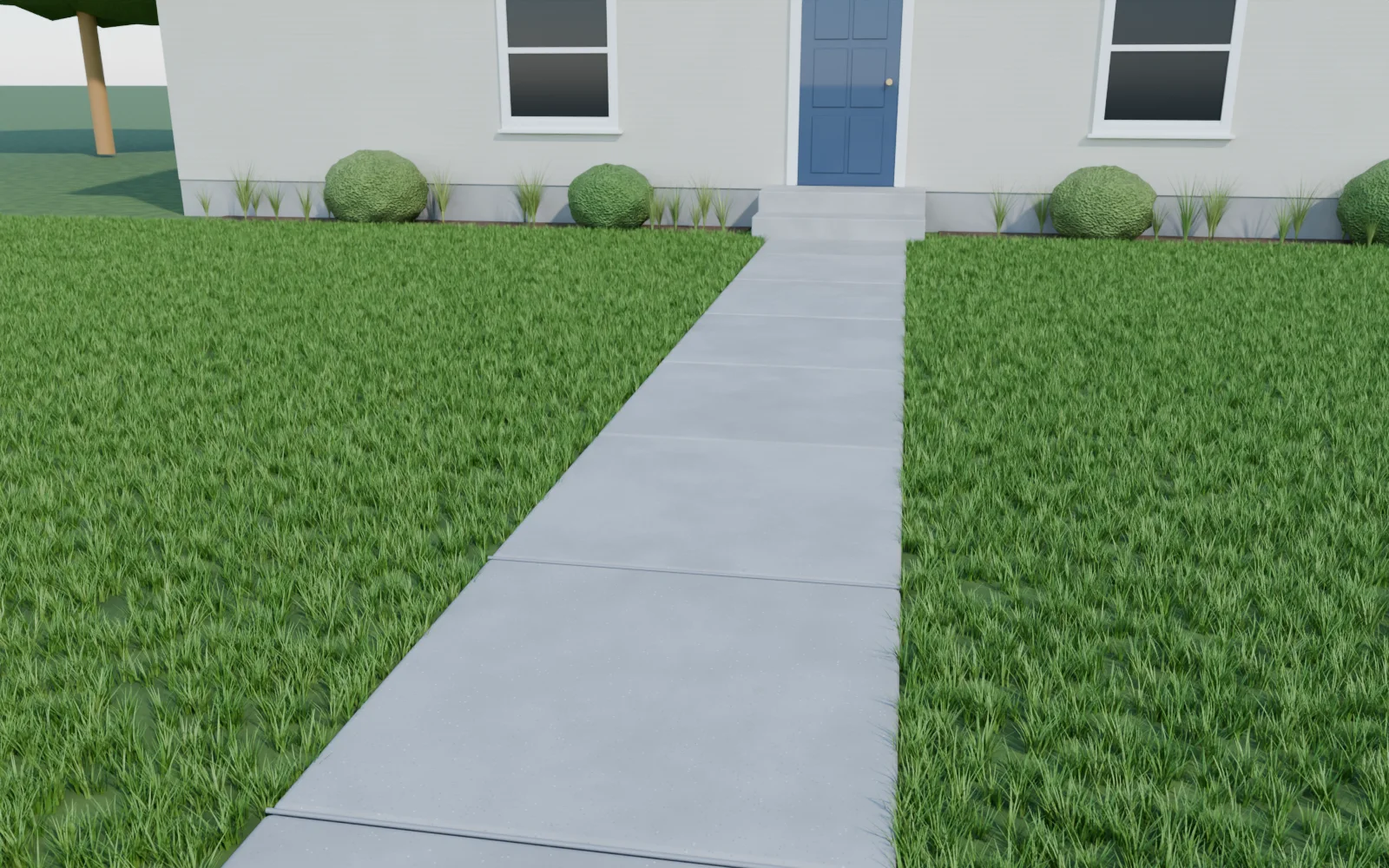
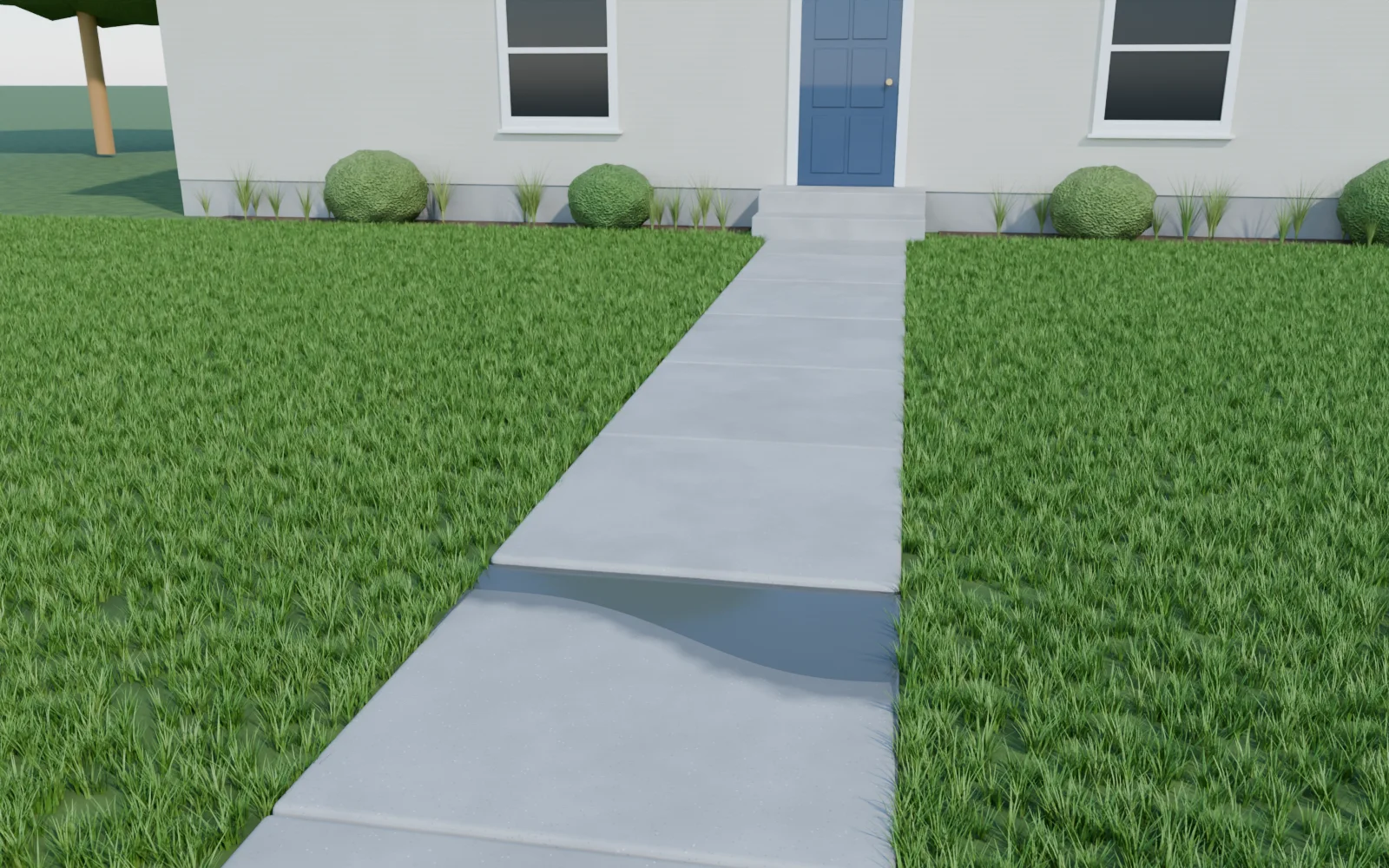
The Math on a Ground Ramp
Here's what grinding actually removes. The ADA standards for accessible routes are a handy yardstick even though your private walk isn't held to them: an edge between 1/4 and 1/2 inch can be beveled no steeper than 1:2, and anything over 1/2 inch is treated as a ramp, which can't be steeper than 1:12.
| Lip height | Bevel at 1:2 | Ramp at 1:12 | Share of a 4-inch slab ground off at the edge |
|---|---|---|---|
| 1/4" | 1/2" long | 3" long | About 6% |
| 1/2" | 1" long | 6" long | About 13% |
| 3/4" | Over the bevel limit | 9" long | About 19% |
| 1" | Over the bevel limit | 12" long | 25% |
| 1-1/2" | Over the bevel limit | 18" long | About 38% |
| 2" | Over the bevel limit | 24" long | 50% |
Worked example: a 4-foot-wide walk with a 1-inch lip, ground to a 1:12 slope, leaves a ground strip 12 inches long by 48 inches wide. That's 4 square feet of a different color and texture at the front of your house, and the edge of the high slab is now 3 inches thick instead of 4 right at the joint. At 2 inches, the strip doubles to 8 square feet and the edge is half its original thickness.
Grind steeper and the ramp gets shorter, but a steep ramp is still a bump for wheels, walkers, and shovel blades. That's why small lips are grinding's sweet spot.
The Tradeoffs That Don't Show Up on a Grinding Quote
| Tradeoff | What happens | When it matters most |
|---|---|---|
| It shows | The ground strip is lighter, rougher, and often exposes the stone inside the concrete | Front walks, colored or stamped concrete, exposed aggregate |
| The cause stays | If the low slab is still sinking, the lip comes back, and the concrete you ground off is gone for good | Slabs near downspouts, sump outlets, or washouts |
| The edge gets thinner | The high slab loses thickness right at the joint, where plow blades and snowblowers hit | Bigger lips; walks that get plowed |
| The finished surface is gone | Grinding removes the troweled top and opens up the concrete under it. Road crews grind pavement too, so it isn't automatically weak, but a fresh surface on an old, salted walk may take freeze-thaw and deicers harder | Walks and aprons that see road salt |
| Silica dust | Grinding concrete throws respirable crystalline silica, which OSHA links to silicosis, lung cancer, COPD, and kidney disease | Every job. Ask about dust control |
Two of those you can do something about.
Seal the ground area. A penetrating silane or siloxane sealer soaks in, doesn't leave a slick film, and is the type with the best record against deicer scaling. Put it on before the strip's first winter. See why seal concrete and freeze-thaw damage.
Ask how they'll control dust. OSHA's construction silica rule lists two setups for handheld grinders: a built-in water feed (outdoors only) or a shroud connected to a dust collector with a high-efficiency filter. A crew grinding dry with neither is a red flag.
Grinding vs. Lifting, Side by Side
| Grinding | Foam lifting | |
|---|---|---|
| What it does | Removes concrete from the high side | Fills voids and raises the low slab |
| Lip from a sunken slab | Hides it by cutting down the good slab | Fixes it by raising the sunken one |
| Lip from a heaved slab | Yes, if the lip is small | Only by raising the neighbors to blend it |
| Rocking or hollow slab | No effect | Fills the void |
| Holds water or drains wrong | No effect | Restores the slope |
| Best lip size | Roughly an inch or less | Any drop on a slab that's mostly in one piece |
| How it looks after | A visible ground strip | Small patched holes; the surface is unchanged |
| If the cause continues | The lip can return | The slab can settle again if water keeps washing soil out |
| Relative cost | Usually lower | Usually higher than grinding, a fraction of replacement |
| Season in Wisconsin | After frost is out, so you're grinding the real lip | Spring thaw to freeze-up |
| Who does it | Concrete contractors, trip-hazard specialists | Us, and other lifting contractors |
When It Takes Both
Lift first, grind a leftover sliver. A slab that sank and also cracked can come up level on one side of the crack and leave a small offset on the other. Lift it, then grind what's left. Never the other way around: grind first and you've cut off concrete on the good slab that you'll wish you had once the low one comes back up.
Root heave on a walk. No method lowers a heaved slab. But raising the neighbors partway shrinks the lip, which shrinks the grinding. A 1-1/2-inch lip lifted down to 1/2 inch needs a 1-inch bevel instead of an 18-inch ramp.
Garage floors getting coated. If a section of the floor sank, we lift it first. Then the whole floor gets ground as part of coating prep. Position first, surface second. We cover the full sequence in leveling an uneven concrete floor.
When It Takes Neither
- A lip under 1/4 inch on a private walk or patio. The ADA yardstick doesn't call for any treatment at that height. Keep an eye on it, and caulk the joint so water stops getting under the slab.
- A raised edge you first noticed in February. Wait until the frost is out. If it settles back, the fix is water management, not grinding.
- Concrete that's crumbling or broken into many pieces. Grinding makes more crumbs, and broken slabs don't lift as one piece. That's replacement. See concrete too damaged to lift.
- A public walk the city has already marked. Find out what the city plans and which repair methods it accepts before you pay anyone.
Grind or Lift? A Five-Question Self-Check
- 1Lay a straightedge across the jointIs the lip over about an inch? Lean toward lifting.
- 2Look down the whole walkIs the odd slab sitting below the line of the others (sank) or above it (heaved)?
- 3Step on the corners and tapRocking or a hollow sound means a void, and that means lifting.
- 4Run the hoseDoes water pond on the low slab or run toward the house or garage? Lifting restores the slope; grinding can't.
- 5Check your before photosHas the lip grown since last year? If so, fix the water and lift. If it's small and hasn't changed in a couple of years, grinding is probably your fix, and you don't need us.