
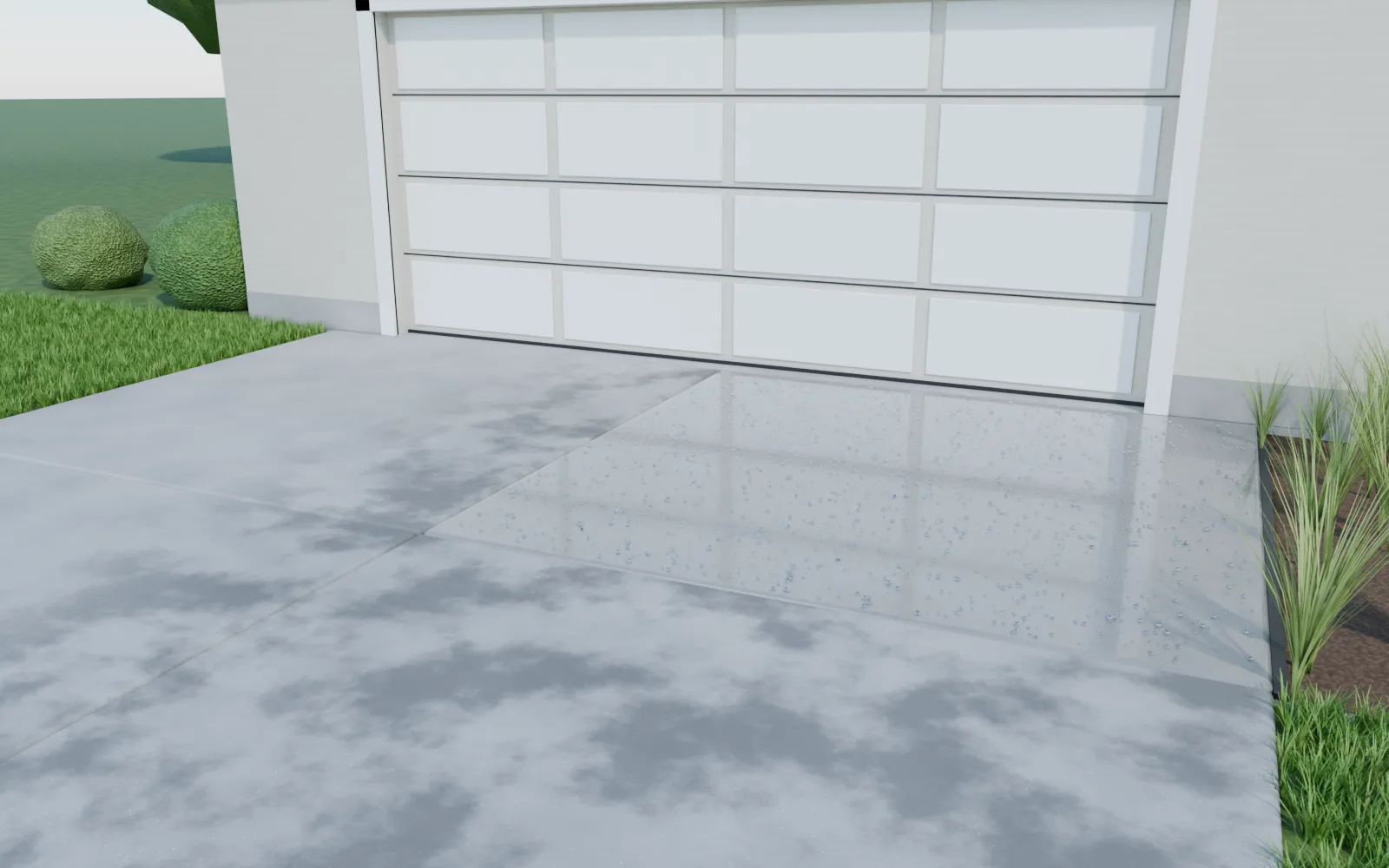
"Driveway sealing" means two different jobs depending on who you ask. To an asphalt crew, it means spraying a fresh black coat on a blacktop driveway. To us, it means soaking a clear sealer into a concrete driveway so road salt and freeze-thaw don't flake the surface.
Both are worth doing on the right driveway. The trouble starts when the wrong product goes on the wrong surface. Here's how to tell which driveway you have, what each job actually does, and who to call. If yours is concrete, that's concrete driveway sealing, and it's one of the things we do.
First: Is Your Driveway Concrete or Asphalt?
| Concrete | Asphalt (blacktop) | |
|---|---|---|
| Color | Light gray, sometimes tan or tinted | Black when new, fading to dark gray |
| Joints | Straight cut lines every 8 to 10 feet | None, one continuous surface |
| Surface | Hard, often a light broom texture | Gritty, stones visible, softer on hot days |
| Edges | Square, formed edges | Rounded, crumbly edges |
If you see cut joints in a grid, it's concrete. Some homes have both: an asphalt driveway that meets a concrete garage apron or a concrete walk. Each surface gets its own product.
What Asphalt Sealcoating Does
Asphalt is held together by a black, tar-like binder. Sun, water and gasoline break that binder down over time, which is why old blacktop turns gray and starts to ravel.
Sealcoating is a black liquid coating spread or sprayed over the surface. It shields the binder and fills fine surface voids, and it gives the driveway its fresh black look back. It wears off with traffic and weather, so it gets reapplied every few years.
It's a paving trade, done by asphalt and sealcoating companies. We don't do it.
What Concrete Sealing Does
Concrete doesn't have a binder that dries out. Its problem is water. Concrete is porous, and in a Wisconsin winter, salt brine soaks into the top layer, freezes, and pops the surface off in flakes. That's called scaling or spalling.
A penetrating sealer (usually a silane or siloxane) soaks into the concrete instead of sitting on top. Water and brine bead up and run off. The concrete still breathes, the color barely changes, and nothing peels. A penetrating sealer often lasts 5 to 10 years, depending on sun, traffic, plowing and salt.
Side by Side
| Concrete sealing | Asphalt sealcoating | |
|---|---|---|
| Goes on | Concrete driveways, walks, aprons, patios | Asphalt driveways and lots |
| Product | Clear penetrating sealer | Black coating |
| Look after | About the same as before | Fresh, dark black |
| Protects against | Salt brine and freeze-thaw flaking | Sun, water and fuel breaking down the binder |
| How often | Often every 5 to 10 years; check with a water test | Every few years |
| Who does it | Concrete care companies like us | Asphalt and sealcoating companies |
Can You Sealcoat a Concrete Driveway?
Don't. Sealcoat is made for asphalt. On concrete it turns the surface black, wears off unevenly in the tire paths, and is hard to get back off. It also doesn't do the one job concrete needs, which is keeping brine from soaking into the surface.
The reverse is true too. A concrete sealer won't restore an asphalt driveway.
What About Glossy "Wet Look" Sealers?
Stamped and colored concrete patios usually get a film-forming acrylic sealer that leaves a glossy, darker finish. It looks great, but it can be slick when wet without a grit additive and typically needs redoing every 1 to 3 years. Glossy resealing of decorative concrete is specialty work we refer to a decorative concrete contractor. For plain driveways, walks and aprons, a penetrating sealer is the better fit.
When to Seal a Concrete Driveway
Early fall, before the first salt, is the best time in Green Bay. The concrete needs to be clean, dry, and inside the sealer's temperature range for the day.
Two things come first:
- Cleaning. Sealer can't soak through grime, oil or salt film. Concrete pressure washing gets the surface ready.
- Joints and cracks. Sealer protects the surface, but it can't close an open joint. Crack and joint caulking keeps water from running under the slab.
To check whether your concrete is still sealed, sprinkle water on it each spring. If it beads up, you're fine. If it darkens and soaks in, especially in the tire paths, it's time.