
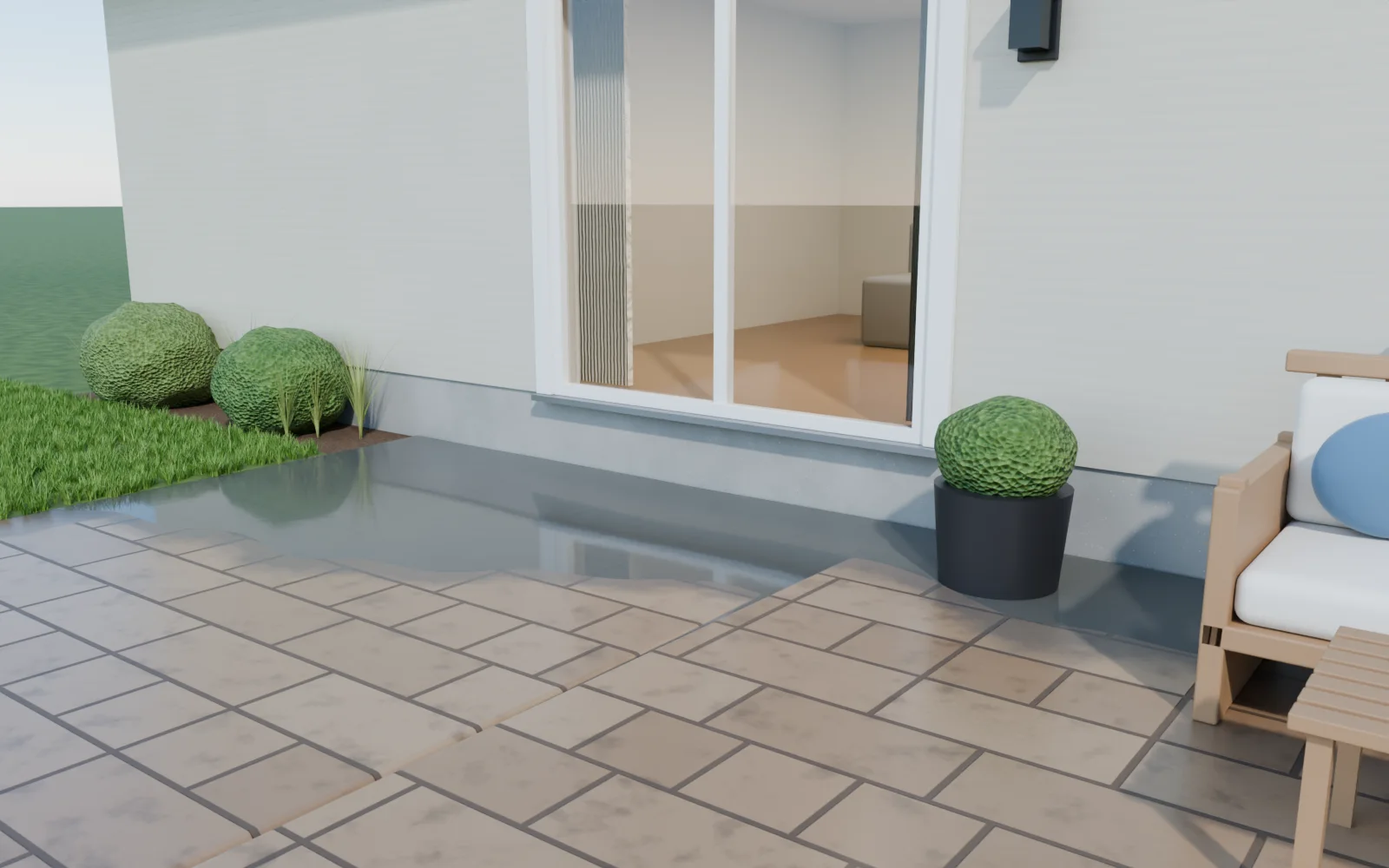
The mower wheel drops off the edge of the driveway every week. After a storm, there's a muddy groove along the front walk, and gravel shows where the grass used to meet the concrete. By the house, the flower bed has crept up until the mulch touches the siding.
Each of those is a grading problem that sends water where your concrete doesn't want it. Here's how high the dirt should be, which way it should slope, what to fill with, and how to check it with a string and a line level.
Why a Bare Slab Edge Turns Into a Sunken Slab
Driveways, walks, and patios sit on gravel or sand over soil, and the edges are where that base is most exposed:
- 1The edge gets exposedMower wheels, foot traffic, plow blades, and runoff wear the sod down until there's a step from concrete to dirt.
- 2Water finds the stepRunoff drops off the slab into that low strip and runs along the edge like a gutter.
- 3The base washes outMoving water carries sand and fine soil from under the slab edge. First you see gravel, then a small cave under the lip.
- 4The edge loses supportA slab with a hollow under its edge cracks or sags there first.
- 5Frost piles onWet clay is frost-susceptible, so the soaked strip heaves in winter and lets the slab settle back lower and crooked in spring.
Much of Brown County sits on red, clay-rich glacial till and old lake clays. Compacted and graded right, clay sheds water well. Saturated, it stays soft for weeks, and spring makes it worse: the ground thaws from the top down, trapping meltwater above soil that's still frozen. WisDOT's spring thaw weight limits, which track that process, average about March 9 to May 9.
How High the Soil Should Sit, Spot by Spot
| Spot | Where the grade belongs | Why |
|---|---|---|
| Driveway, walk, or patio edge | Flush with the top of the slab or slightly below, then falling away | Water steps off onto the lawn instead of running along or under the edge |
| Grass beside a slab | Soil and thatch at or just under the concrete | Sod built up above the slab dams water on the concrete, where it freezes into an ice strip |
| Against wood siding or trim | At least 6" below the wood, and at least 2" between wood and a stoop or patio slab | The model building code treats wood closer than that as needing decay protection |
| Against the foundation wall | At least 6" of foundation showing (4" with brick or stone veneer) | The model code minimum |
| Landscape beds beside concrete | Finished mulch or stone below the slab edge | A bed that rises above the slab traps water against it |
Those siding and foundation numbers come from the International Residential Code, a widely used model building code. It says wood siding, sheathing, and framing closer than 6" to the ground, or 2" above a concrete step, porch, or patio slab, has to be naturally rot-resistant or pressure-treated, and that foundation walls should stand at least 6" above finished grade (4" with masonry veneer). Siding makers set their own clearances too. If your house is already short on clearance, don't pile on dirt to fix the slope. Get the slope by lowering the far end instead.
How Much Slope Away From the House
The number to remember is 6 inches of fall in the first 10 feet. That's what the International Residential Code (section R401.3) calls for around new houses, and it's a good target for any house: a 5 percent slope, a bit over 1/2" per foot.
- Paved surfaces within 10 feet of the house should slope away at least 2 percent, about 1/4" per foot.
- Local rules can differ. Fond du Lac's residential drainage requirements, for example, call for at least 1/2" per foot for 10 feet, or to the lot line if that's closer. Check with your municipality before a big regrade.
- Tight side yards that can't fit the full drop usually get a swale: a shallow, wide grass channel that carries water along the house and out to the front or back instead of toward the wall.
And don't aim the water at the neighbor's yard. That trades your problem for an argument.
Check Your Grade With a String, a Line Level, and a Tape
You need two wooden stakes, mason's string, a line level (a tiny level that hangs on the string), and a tape measure.
- 1Drive one stake against the foundation and another 10 feet straight out.
- 2Tie the string to the wall stake at an easy height, like 12" above the ground.
- 3Level the string. Hang the line level in the middle and slide the string up or down the far stake until the bubble centers. Flip the level end for end and check again; line levels are touchy.
- 4Measure from the string down to the ground at both stakes and subtract. The far number minus the wall number is your fall over 10 feet.
Passing grade: At the wall, the string is 12" above the ground. At 10 feet, it's 18". Fall: 18 − 12 = 6". That's 6" over 120", a 5 percent slope, right on target.
Failing grade: At the wall, 12". At 10 feet, 13-1/2". Fall: 1-1/2", a quarter of what you want, so you need 4-1/2" more. If clearance allows, build up 2" at the wall, tapering to nothing about 5 feet out, and cut the far end down 2-1/2" into a shallow swale: 1-1/2 + 2 + 2-1/2 = 6". If the wall has no clearance to spare, all 4-1/2" comes from lowering the far end.
Repeat every 10 to 15 feet along each wall and wherever a downspout empties.
Checking a slab instead: Set a 4-foot level on the slab with one end at the house, pointing straight out. Lift the outer end until the bubble centers. A gap of about 1" under it means about 2 percent, or 1/4" per foot, falling away. No gap, or a level you have to lift at the house end, means the slab runs flat or toward the house, which regrading won't fix.
Topsoil, Clay, Sand, or Stone: What to Fill With
| Material | Good for | Not good for |
|---|---|---|
| Screened topsoil (often sold locally as "black dirt") | The top few inches, so grass and plants grow | Building the whole grade; it's loose, holds water, and settles |
| Clay-rich fill (including the red clay you dig up) | The bulk of a regrade and the layer against the foundation; compacted, it sheds water | The final surface, because grass struggles in bare clay |
| Mulch | Topdressing beds | Building grade; it breaks down, floats off, and holds moisture against whatever it touches |
| Sand, gravel, or decorative stone | Paver bedding, drip edges, beds over soil that's already sloped right | Building grade; water passes through and follows whatever slope is underneath |
The best regrade is layered: compacted clay-rich fill to set the slope, a few inches of topsoil on top. U.S. Department of Energy building guidance recommends capping backfill next to the house with 2 to 4 inches of compacted silty clay.
How much to buy: Raising a strip 3 feet wide along a 40-foot driveway edge by an average of 2" takes 3 × 40 × (2 ÷ 12) = 20 cubic feet. A cubic yard is 27 cubic feet, so that's about 3/4 of a yard, plus a little extra for settling.
Filling Washouts Along Driveway and Walk Edges
- 1Probe before you fill. Slide a long screwdriver or a piece of rebar under the slab edge. If it stops after an inch or two, it's a surface washout. If it slides in several inches, there's a void under the slab, and dirt packed into the opening won't fill it or hold the slab up.
- 2Find the water. A downspout, a sump line, a low spot, or a plow pile melting in the same place every spring carved that washout. Fix the source first.
- 3Clean out washed-in gravel and debris so new fill sits on firm soil.
- 4Fill a couple of inches at a time with damp (not muddy) clay-rich fill, tamping each layer firm with a hand tamper or the end of a 4x4.
- 5Finish with topsoil and seed or sod, flush with the slab or slightly below and sloping away.
Beds and Edging Next to Concrete
- Rake back before you top up. Pull some of last year's mulch out before spreading new, and keep the surface below the slab edge and 6" below the siding.
- Set edging below the slab surface. Edging, timbers, or pavers set higher than the concrete form a small dam that holds water against the slab.
- Check the soil under stone beds, not the stone. Water runs through the rock, hits the soil or plastic sheeting underneath, and follows its slope. If that layer tips toward the house or patio, a bed that looks fine on top is steering water the wrong way.
New Fill Settles, and Frost Moves It
Fresh fill is fluffier than the soil around it, so it settles. Energy-efficiency building guidance calls for compacting backfill or topping it up after the first rainy season; plan on both. Never grade with frozen soil or on frozen ground, because frozen chunks thaw into soft pockets, and don't trust a new grade until it has been through a spring.
| When | What to do |
|---|---|
| Late March–April | Look, don't dig. The ground is saturated, but it's the best time to see where water stands. Take photos. |
| May–June | Prime grading season. The frost is out, the soil is drying, and seed has all summer to root. |
| July–August | Workable, but dry clay is hard to compact, and seed needs steady watering. |
| September–early October | A strong second window. Fall rains settle the fill before freeze-up. |
| Late October on | Normal lows dip below 40°F and the ground starts freezing. Make notes for spring. |
What You See, What It Means, and the Fix
| What you see | What it means | Fix |
|---|---|---|
| An inch or more of drop from slab to lawn | The edge is exposed, and runoff will follow it | Fill and tamp in layers, topsoil, seed |
| Gravel showing or a gap under the slab edge | The base is washing out | Probe it: shallow means fill; deep means a void under the slab |
| A muddy groove along a slab after rain | Water is running along the edge | Regrade so it falls away; find the source |
| Sod higher than the slab, puddles on the concrete | Grass and thatch have built up | Cut out the edge strip and set it lower |
| Mulch or soil touching siding | No clearance; rot risk | Pull it back to at least 6" below the wood |
| Water near the foundation a day after rain | A low spot or reverse slope | Regrade for 6" in 10 feet; check downspouts |
| Slab edge cracked off, sagging, or tipped toward the house | Water already undermined it | Lift the slab and fill the void, then regrade |
| New fill sunk after the first spring | Normal settling | Top it up and reseed |
Call Diggers Hotline Before You Dig
Wisconsin law (Wis. Stat. 182.0175) requires anyone digging, homeowners included, to contact Diggers Hotline at least three working days ahead. Dial 811. Regrading, cutting a swale, setting edging, and trenching a downspout line all count, and the strip along the house is right where utility lines come in.
Your Part, and Where We Come In
You don't need us for most of this. Regrading, filling washouts, resetting beds, and extending downspouts are weekend jobs. We don't do landscaping or yard grading.
We handle the damage water already did. When a slab sank because its base washed out, we lift it with high-density polyurethane foam through 5/8" holes, about the size of a dime. The foam fills the voids as it raises the slab, it's waterproof once cured, and you can drive on it the same day. If the slab tipped toward the house, we lift it so it pitches away and then seal the joint at the foundation.
Doing both? Lift first, then regrade. A lifted slab sits higher than before, so soil set to the old height leaves the edge exposed again.