
Most people find sunken concrete by accident. The snowblower stops dead on a sidewalk joint. A guest catches a toe on the stoop. The patio table wobbles no matter which way you turn it.
By then, the slab has usually been moving for a while. You don't need anyone to come out and diagnose it. You need a tape measure and a slow lap around the house.
This is the walk we'd take: start at the front door, work around the house, and finish at the street. Each stop covers what to look for, how to measure it, and when it's worth fixing.
Before You Start: Tools, Timing, and Some Level Math
Grab these: a tape measure, a 4-foot level (a 2-foot level for the AC unit), a straight 8-foot 2x4, a golf ball or marble, painter's tape or chalk, your phone, and a garden hose if it isn't raining.
Pick the right time. Frost pushes slabs around all winter here, and WisDOT's spring thaw weight limits run on average from about March 9 to May 9. Measure in late May or later, or in early fall before freeze-up. A slab that looks sunk in March may just be next to a frost-heaved neighbor. If you can, also walk it during a good rain to see where the water goes.
Reading a Slope With a 4-Foot Level
Set the level on the slab, pointing away from the house. Lift the low end until the bubble centers, then measure the gap under that end.
| Gap under the end of a 4-foot level | Slope | What it means near the house |
|---|---|---|
| 1" or more, low end away from the house | About 2% or steeper | Good. That's the minimum the model building code calls for on paved surfaces within 10 feet of a foundation. |
| 1/2" to 1" | About 1–2% | Drains, but slowly. Watch it. |
| Under 1/2" | Close to flat | Water will sit. |
| You had to lift the end nearest the house | Toward the foundation | The slab is sending water at your basement wall. |
On a 2-foot level, halve those numbers: a 1/2" gap is about 2%.
Stop 1: The Front Stoop and Steps
Look for a gap opening where the stoop meets the house, a landing pitched toward the door, a step that rocks or sounds hollow, or a storm door that has started dragging.
Measure it:
- 1Measure each riser (the height of each step) at the center. When a stoop sinks, the step from the landing up to the threshold grows and the bottom step shrinks.
- 2Set the level on the landing pointing out from the door. It should fall away from the house.
- 3Tape across the gap at the house and write the date on it. If the tape tears by next season, it's still moving.
Worth fixing when: Wisconsin's building code for new one- and two-family homes caps risers at 8" and says the tallest riser in a set shouldn't exceed the shortest by more than 3/8". Your existing stoop isn't held to that, but it's a good yardstick, because uneven steps are what trip people. Risers off by more than about 3/8" are a this-season fix. A landing tipping toward the door, or a rocking step, is a fix-now.
Stoops tied into the foundation can be harder to lift; photos usually tell us which kind you have.
Stop 2: The Front Walk
Look for lips at the joints, a panel tipped toward the lawn or house, and the one square that stays wet long after the rest dry.
Measure it: Lay the straightedge on the higher panel so it hangs over the lower one, and measure the gap at both sides of the joint. Equal numbers mean the panel dropped evenly. Different numbers mean it tipped.
Worth fixing when: The ADA standard for accessible walking surfaces doesn't cover your private walk, but it's the best yardstick there is. It allows up to 1/4" of vertical change, wants 1/4" to 1/2" beveled, and treats anything over 1/2" like a ramp. So:
- Under 1/4": watch it.
- 1/4" to 1/2" on a daily path: fix it this season.
- Over 1/2": someone will catch a toe. Fix it now.
On the public sidewalk, check with your municipality first. In Green Bay, owners are responsible for the sidewalk in front of their property, and public walks are right-of-way work that needs a permit. See our uneven sidewalk guide and ADA sidewalk article.
Stop 3: Along the Foundation
Nobody trips here, so people skip it. It's also how water reaches your basement.
Look for slabs tipped back toward the wall, an open gap between concrete and foundation, a trench of settled soil along the wall, and downspouts or a sump line dumping beside a slab.
Measure it: Use the level on every slab that touches the house, pointing straight out from the wall. Then run water on the slab next to the wall for a minute, or watch during a rain. It should run away from the house. If it runs toward the wall or vanishes into the gap, you've found your problem.
Worth fixing when: A slab that's flat or sloping toward the house is a this-season fix, and a fix-now if that side of the basement already gets wet. One that falls away, just not quite enough, goes on the watch list. Once a slab pitches the right way, seal the gap at the wall with flexible sealant over backer rod; seal it while it's tipped in and you lock in the bad slope. See caulking where concrete meets the house and how to extend downspouts.
Stop 4: The AC or Heat Pump Pad
Look for a unit leaning toward the house, copper lines that look stretched, and a gap under one edge of the pad. Measure with a 2-foot level on top of the unit, both directions.
Worth fixing when: Many installers aim for within about 1/4" of level. Past that, or tipping toward the foundation, fix it this season. If the lines already look tight, call your HVAC company before anyone lifts it. A lightweight plastic pad is an HVAC re-level, not a concrete job. Details in our sinking AC pad guide.
Stop 5: The Back Patio
Look for puddles that linger against the house or patio door, a corner that rocks, furniture that suddenly wobbles, and a diagonal crack cutting off a corner (often a sign of a void).
Measure it: Set a golf ball down a foot from the house in a few spots. It should roll away from the house. If it rolls toward the wall or just sits, confirm with the level. (On a rough broom finish, use a tennis ball.) After a rain, chalk the outline of any puddle. Step on every corner, and tap with a hammer handle to listen for a hollow sound; our voids guide explains what that means.
Worth fixing when: A slope toward the door, a puddle against the wall, or a rocking corner are this-season fixes. A shallow puddle in the middle of a slab that otherwise drains fine is usually a low spot from when the concrete was finished. Lifting moves whole slabs. It doesn't reshape the surface of one, so that dip stays a dip.
Stop 6: The Garage Floor
Look for a crack with one side lower than the other, the floor dropping near the door or pulling away from the walls, snowmelt running toward the house door instead of out, and daylight under one end of the closed overhead door.
Measure it: Bridge cracks with the straightedge and measure the step. Roll a ball from the back wall toward the door; garage floors are normally built to drain toward the vehicle door or a floor drain. Close the door and measure the gap under the seal at both ends. If the door itself checks out level, an uneven gap points to the floor.
Worth fixing when: A crack stepped more than about 1/4", water heading toward the house door, or a seal gap past about 1/2" are this-season fixes. Planning a garage floor coating? Lift first and coat second. Hairline cracks with both sides level are normal; see garage floor cracks.
Stop 7: The Driveway and Apron
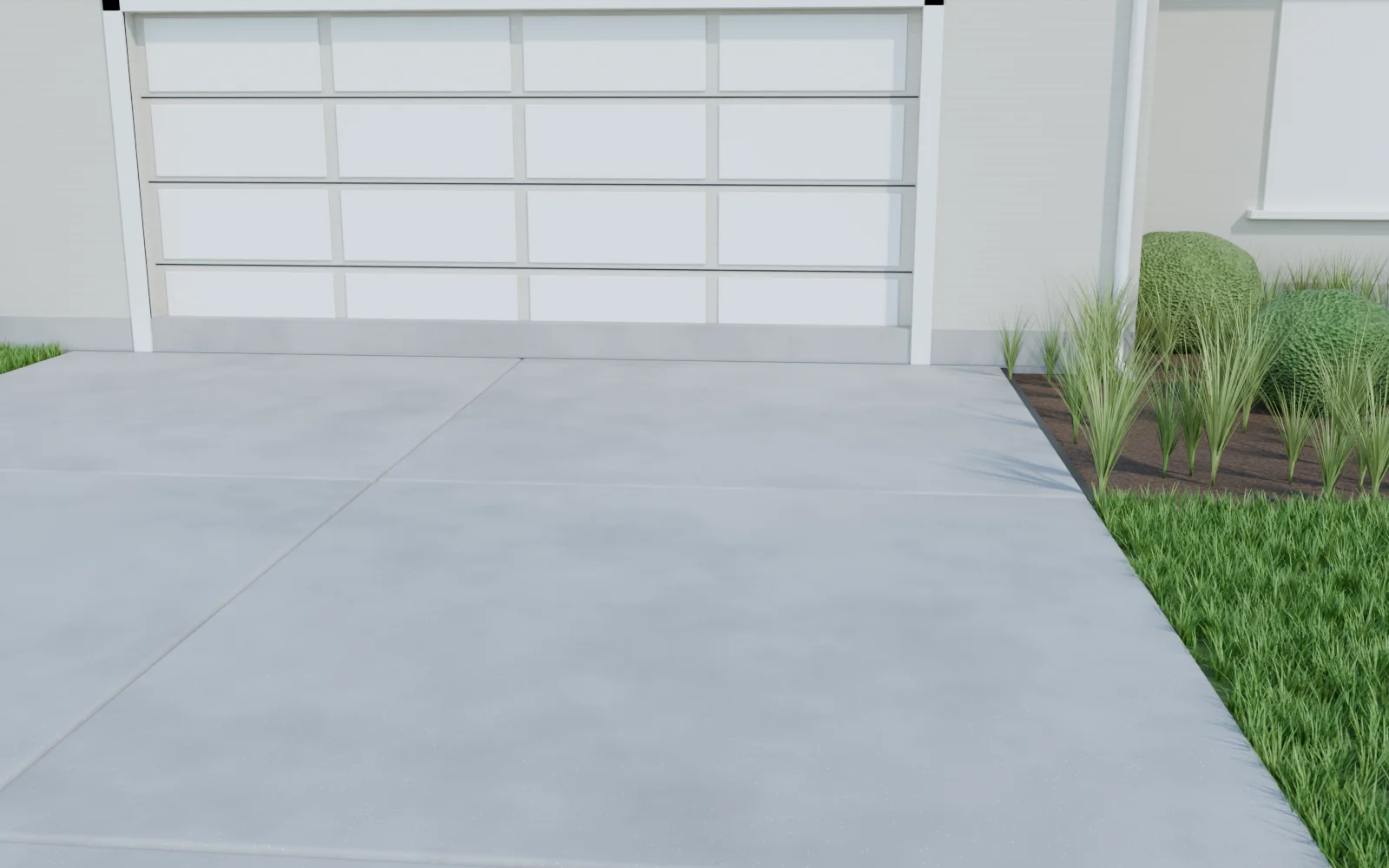
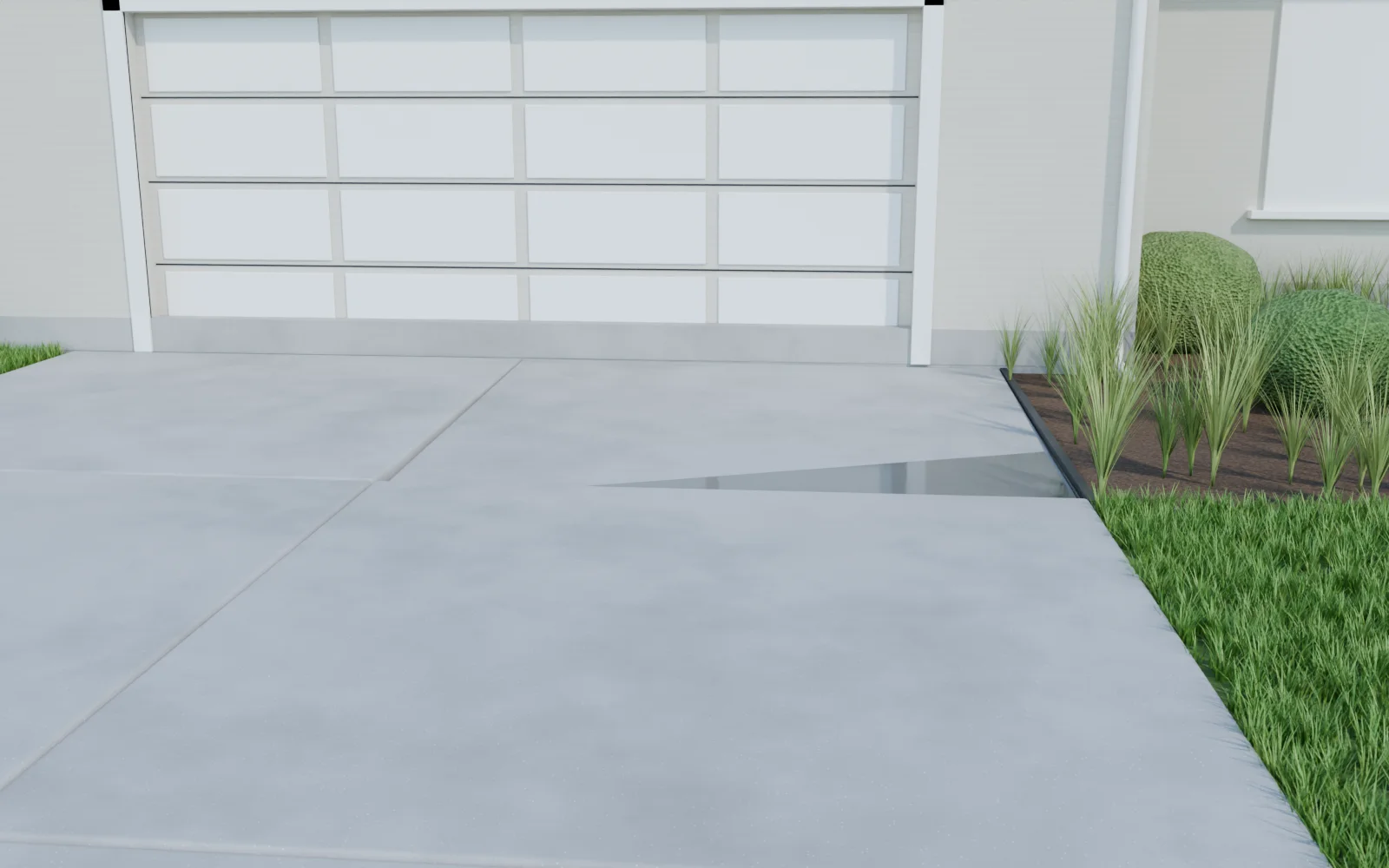
The apron, the slab right outside the garage door, sits on the same loose backfill as the stoop and carries every car.
Look for a step down from the garage floor, a bumper that scrapes, water pooling at the garage door (a frozen-shut door in January), a slab that clunks under a tire, and corner cracks.
Measure it: Lay the straightedge on the garage floor reaching out over the apron and measure the drop. On a long drive, stretch a string between bricks set on slabs that haven't moved and measure down to the ones between. Then have someone drive slowly over each joint while you watch for a slab edge that moves.
Worth fixing when:
- Drop under 1/2", water still runs away: watch it.
- 1/2" to 1", or water heading toward the garage door: fix it this season.
- Over 1", or a slab that rocks under the car: fix it now. A slab bridging a void under a car can crack, and a cracked-up slab can turn a lift into a replacement.
The stretch out by the street may not be yours alone. In Green Bay, the public sidewalk and the driveway section between it and the curb are right-of-way, and work there needs a permit and a city-licensed builder. Call Public Works first.
The Severity Table: Watch, Fix This Season, or Fix Now
These are our working thresholds, built off the yardsticks above, not code requirements for your house.
| Where | Watch it | Fix this season | Fix now |
|---|---|---|---|
| Front walk | Lip under 1/4" | 1/4"–1/2" on a daily path | Over 1/2", or someone already tripped |
| Stoop and steps | Risers within 3/8", landing falls away | Risers off more than 3/8", gap at house growing | Landing tips toward the door, or a step rocks |
| Along the foundation | Falls away, but less than 1" per 4 feet | Flat or sloping toward the house, or an open gap at the wall | Sloping toward the house and the basement gets wet |
| AC pad | Within 1/4" of level | More than 1/4" off | Lines stretched or kinked (call HVAC first) |
| Patio | Small puddle away from the house | Slopes toward the door, puddle at the wall, or a corner rocks | Its water is reaching the basement |
| Garage floor | Hairline cracks, both sides level | Stepped crack over 1/4", water toward the house door | Floor dropping at the wall, or a section rocks |
| Driveway and apron | Drop under 1/2" | 1/2"–1", or water toward the garage door | Over 1", or a slab rocks under the car |
One sign trumps all of these: change. A 3/8" lip that's held for five years is less urgent than a 1/4" lip that was 1/8" last spring.
When It's Not a Lifting Problem
Plenty of concrete trouble looks like sinking from the kitchen window and isn't.
| What you see | What it probably is | The right fix |
|---|---|---|
| A slab riding higher than its neighbors, worst in February and March, better by June | Frost heave | Wait for the thaw, re-measure, fix drainage. See frost heave vs. settling. |
| A hump or high edge on the side facing a tree | Root heave | Lift the neighbors to blend it, grind a small lip, or replace. See tree roots lifting concrete. |
| Flaking, pitting, or exposed stones, slab still level | Scaling or spalling from salt and freeze-thaw | Seal sound concrete; resurface or replace the worst. See concrete spalling causes. |
| Crumbling edges, or a slab in many loose pieces | Deteriorated or broken concrete | Replacement by a concrete contractor. Read questions before replacing concrete. |
| Hairline cracks, both sides at the same height | Normal shrinkage cracking | Leave them, or seal the wider ones. See concrete crack types. |
| Cracks or bowing in basement walls, sticking interior doors | A foundation issue | A structural engineer or foundation specialist |
| Dark patches, green film, or oil stains | A cleaning job | See our concrete cleaning guide. We do that too. |
Lifting raises concrete. It can't push a heaved slab down, glue a broken one together, or resurface an old one. If your walk-around turned up mostly this table, you may not need us at all.