
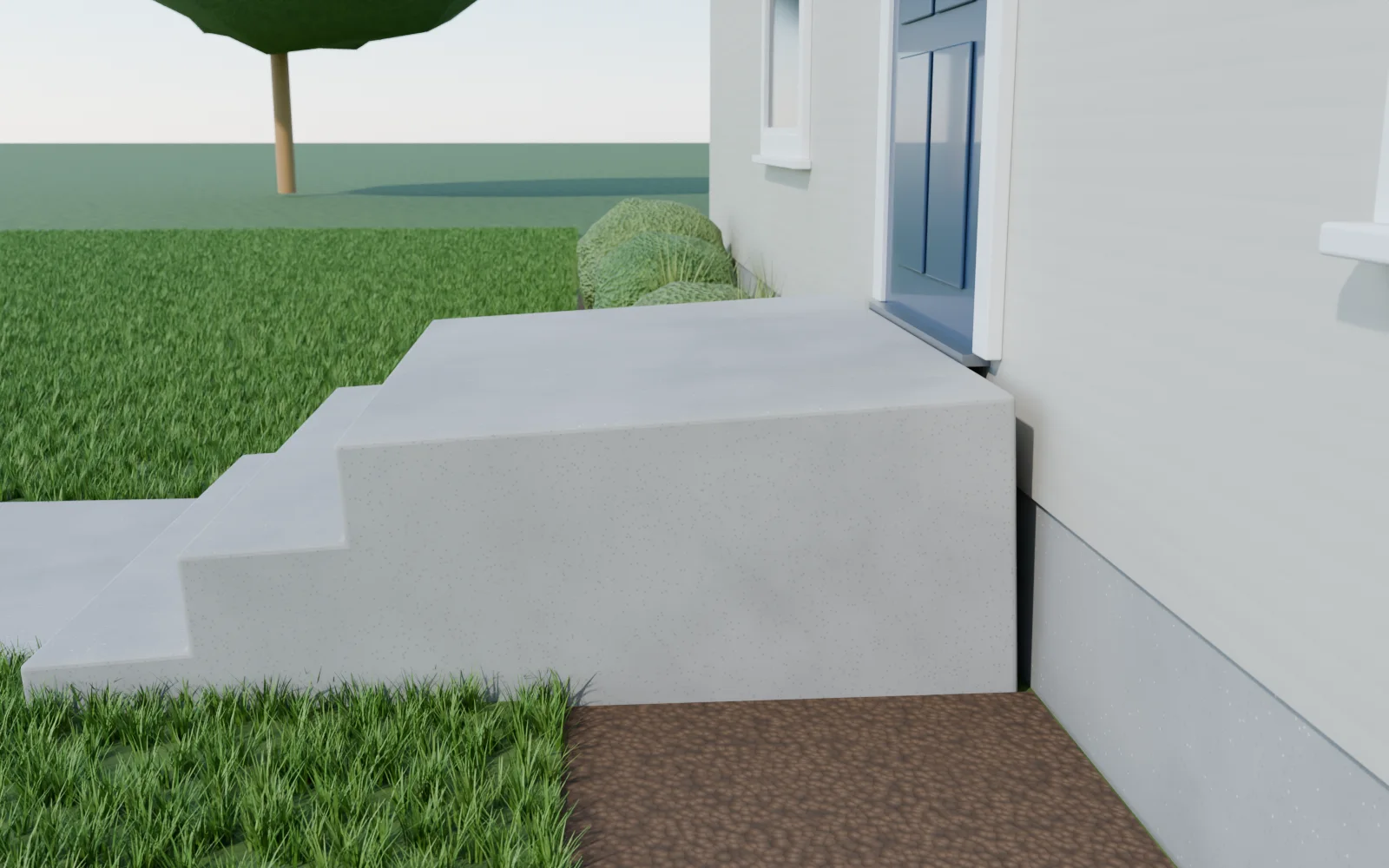
It usually starts with a gap. A thin line opens where the top step meets the house, and every spring it's a little wider at the top than at the bottom. Then the top step ends up lower than the door threshold, the railing starts to lean, and the bottom step gets taller than the rest.
None of that is the house moving. It's the stoop. And in most cases it can be lifted back where it belongs instead of torn out and repoured. That's what step and stoop lifting is: the same foam concrete leveling we do on driveways and walks, aimed at the heaviest piece of concrete on your property.
If you've been searching for mudjacking, this is the modern version: the same idea, but with lightweight foam through dime-size holes instead of heavy slurry. (Here's how they compare.)
The Two-Minute Stoop Check
Grab a tape measure and a level.
- 1Look at the gap at the wallWider at the top than at the bottom means the stoop is tipping away from the house.
- 2Check the top step against the doorIt should sit just below the threshold and slope slightly away from the house. If it's well below the threshold, or water runs toward the door, it has dropped.
- 3Measure every riserSteps that used to match now don't. The bottom step is usually the tall one, because the walk at its foot dropped too.
- 4Look at the railingA post that leans, or a bracket pulling away from the wall, moved with the stoop.
- 5Look at the sidesA crack across a solid stoop is common and often fine. A stoop split into chunks that rock separately is a different story.
If you see two or more of these, it's worth sending photos.
Why Front Steps Sink
When your house was built, the basement hole was dug wider than the walls. After the walls went up, that extra space was backfilled, often loosely, and it keeps settling for years. Your stoop was poured right on top of it.
The house doesn't have that problem. Wisconsin's building code puts house footings at least 48 inches below grade, below the frost line. The stoop sits on a few feet of loose fill instead. So when the soil settles, the stoop goes down and the house stays put.
Water speeds it up:
- A downspout that empties at the corner of the stoop
- A gap at the wall that lets every rain run straight down behind the steps
- Grading that slopes toward the house instead of away
- Frost, which lifts wet soil in winter and lets it drop back in spring, a little crooked each time
That's why a stoop that moved a little usually keeps moving. The gap lets more water in, the water softens more soil, and the gap gets bigger.
Concrete Step Repair Options, Side by Side
| Option | What it does | The catch |
|---|---|---|
| Caulk the gap only | Keeps water out of the space behind the steps | Doesn't bring the stoop back. Sealing a stoop that already tipped locks in the bad slope. |
| Mudjacking | Pumps cement slurry under the stoop to raise it | Holes about 1 1/2 to 2 inches wide in a very visible spot, and 100 to 150 pounds per cubic foot of fill on soil that already settled |
| Foam lifting | Fills the voids and tips the stoop back toward the wall through 5/8-inch holes | Solid, one-piece stoops only. Hollow shells need a look first. |
| Tear out and repour | A brand-new stoop | The most expensive route, days without your front door, and the new steps go right back on the same backfill |
For most solid stoops, lifting is the fix that addresses the actual problem: the stoop dropped, and it needs to come back up.
When Lifting Isn't the Answer
We'll tell you from the photos if your stoop isn't a good candidate. The usual reasons:
- It's broken into pieces that move separately. Foam can raise a cracked stoop that still moves as one piece, but it can't lift loose chunks together.
- It's a thin hollow shell. Some stoops are a concrete shell over fill or an empty space. Some of those can be filled and lifted. Some are too thin or too cracked to lift safely.
- The concrete is crumbling. Heavy flaking on the treads and edges means the surface is failing. Lifting won't fix that.
- It's pinned to the foundation. A stoop tied into the wall or sitting on a ledge behaves differently from a slab on grade. Photos of the sides and the spot where it meets the house tell us which you have.
How We Lift a Stoop
- 1Measure first. We check the slope, the gap at the wall, and every riser, and agree on the target before we drill.
- 2Drill a few small holes through the landing and the lower step, about 5/8 inch across.
- 3Inject foam a little at a time. It fills the hollow under the stoop first, then tips the outer edge up so the stoop leans back toward the wall.
- 4Bring the walk up to meet it if the walk square at the bottom step dropped too, so the bottom riser matches the others again.
- 5Patch the holes and seal the gap at the foundation, so water runs off the front of the steps instead of down behind them.
Most stoops take one to three hours on site, and you can use the steps the same day.
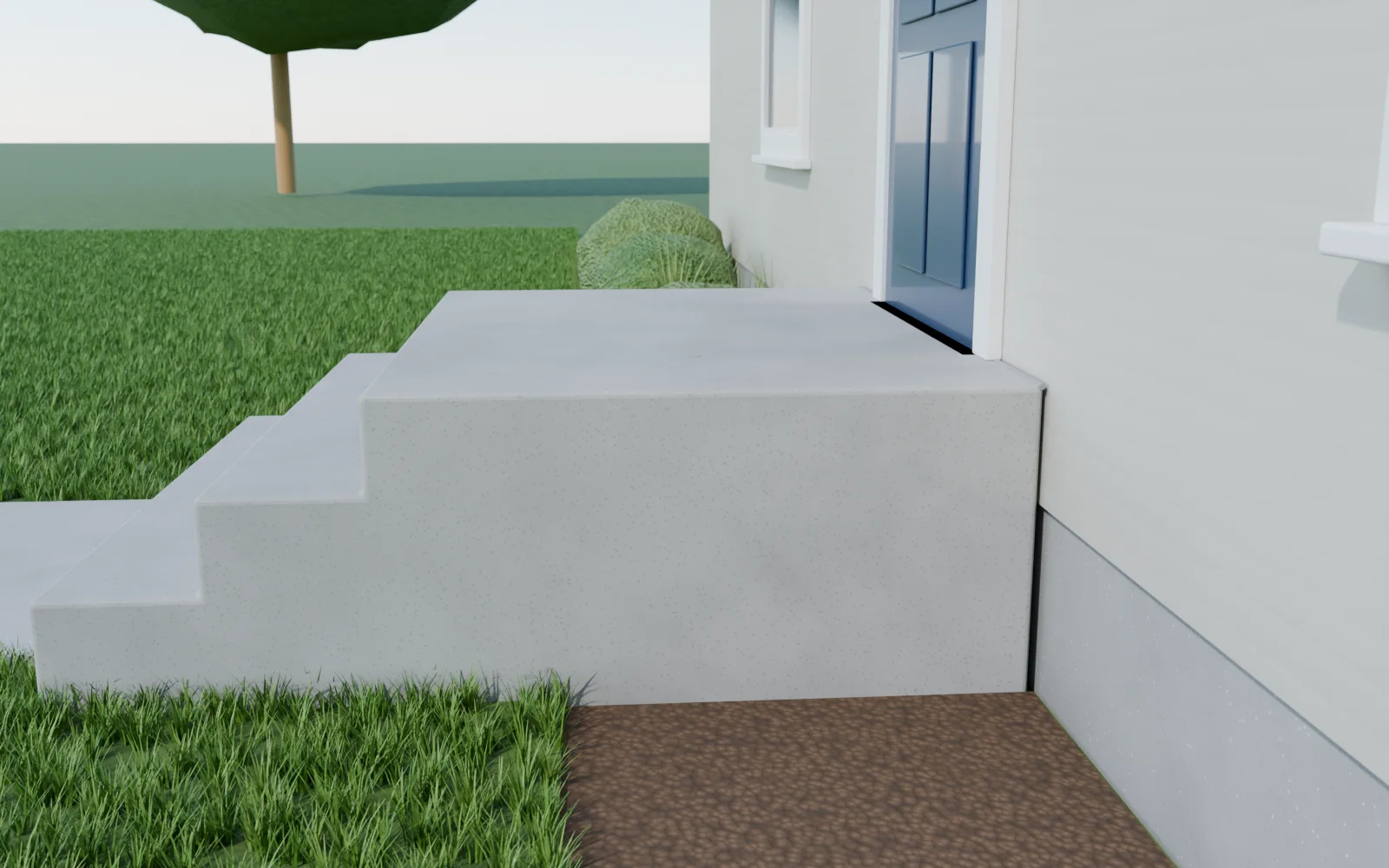
3D renders with the ground cut away, simplified to fewer holes than a real job. Most residential jobs take a few hours, and you can walk on the slab when we pack up.
Fix the Water, Then Seal the Gap
Lifting fixes the stoop. Keeping it there is about water:
- Extend the downspout nearest the steps so it lets out several feet away. (How to extend downspouts.)
- Seal the joint where the stoop meets the house with a flexible sealant over backer rod. That's joint caulking, and it's the step that keeps rain from soaking the fill behind the steps again.
- Build the grade up along the sides of the stoop so soil slopes away from the house.