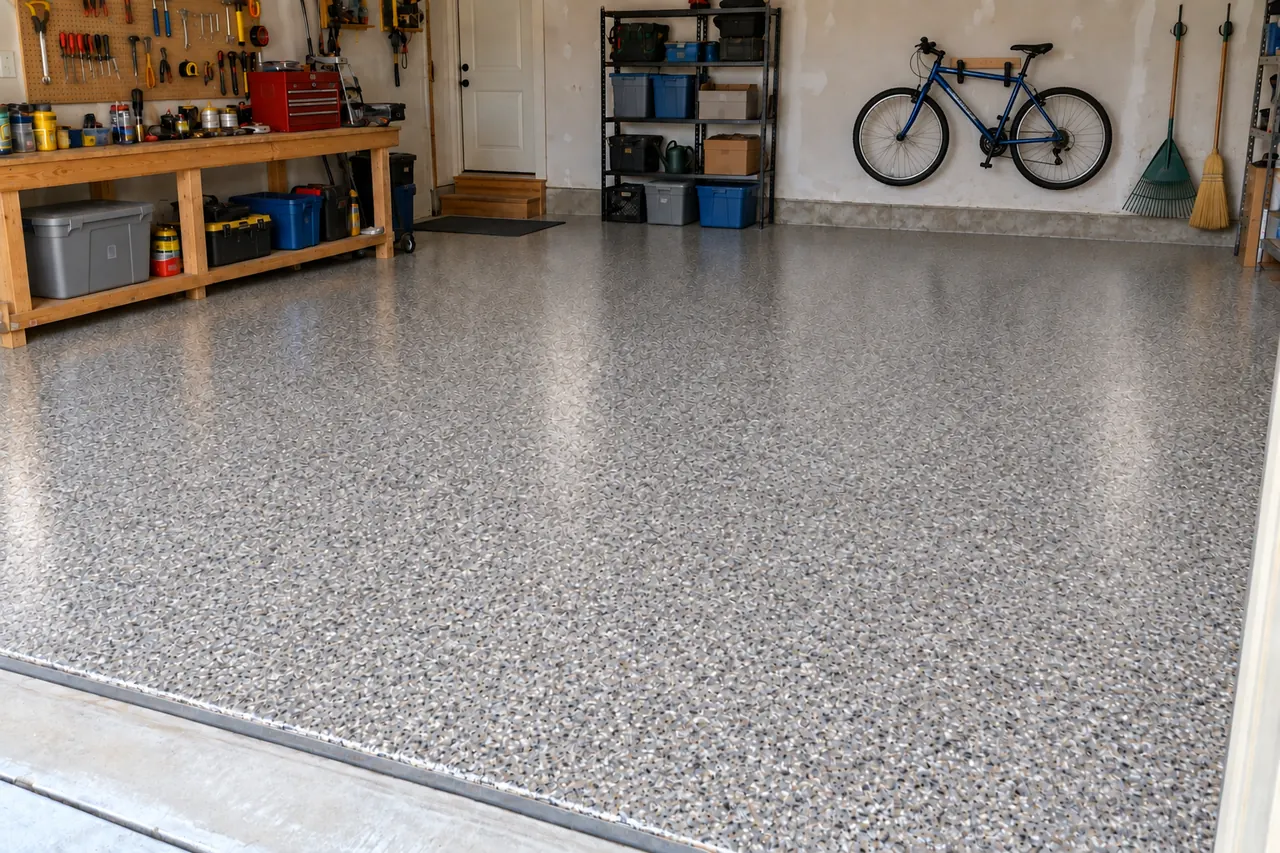
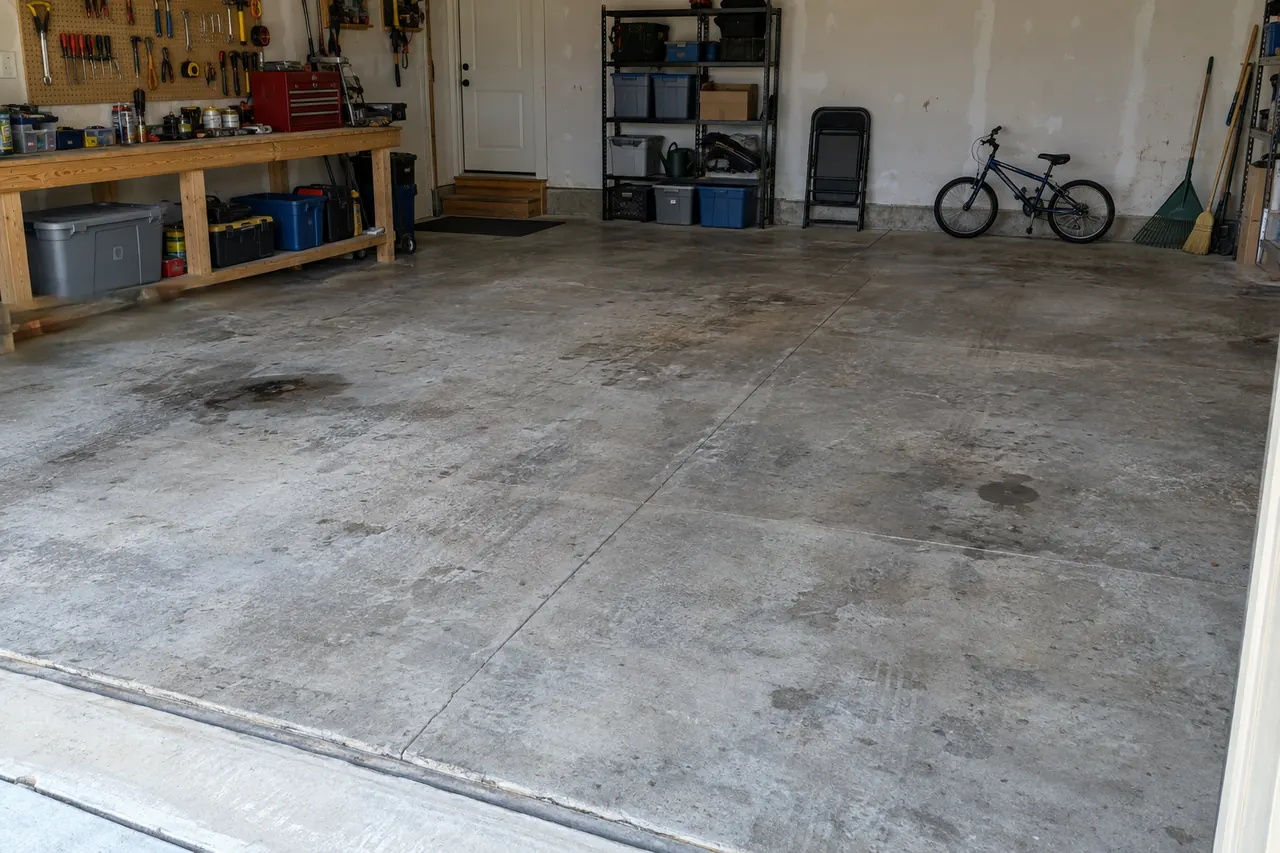
A stained, cracked garage floor, ground, repaired and coated with a full-broadcast flake system. Drag the slider. Example images, not a customer's job; photos from local jobs replace them as we finish them.
The short answer
A shop or pole barn floor takes oil, hydraulic fluid, road salt and dropped tools. A polyaspartic coating keeps all of it on top of the concrete, where it wipes up, and a flake finish adds grip. We diamond grind the slab, repair it, and coat it in full flake, partial flake or solid color, checking temperatures first in unheated buildings.
By Rob Diederich, owner · Updated
Good for
Shops, pole barns, detached garages
Prep
Diamond grind, CSP 2–3
Park on it
24–48 hours
Warranty
Written warranty
What a coated shop floor handles
✓Oil, hydraulic fluid and coolant sit on top instead of soaking in, so a drip is a wipe, not a stain.
✓Road salt and slush off trucks and equipment stay on the surface, where a squeegee takes them out the door.
✓Concrete dust stops. Bare concrete sheds fine dust that gets into everything; a coated floor doesn't.
✓Grip comes from the flake texture, and grit can be added where the floor gets wet.
✓Light goes further. A light flake or solid color floor makes the whole building brighter.
Unheated buildings and cold slabs
Every coating has minimum temperatures for the air and the slab, and a cold pole barn can sit below them for months. Polyaspartic cures at lower temperatures than epoxy, which widens the season, but we still check the slab before we schedule. In a building without heat, late spring through early fall is the easy window.
New slab? Let it cure first
A pole barn slab poured this year still has water working its way out. Coating it too soon traps that moisture under the coating. The usual rule is to let new concrete cure at least about a month first, and we test it before we coat.
Tractors, lifts and floor drains
A coating takes rubber tires, jack stands and creepers in stride. Steel tracks, chains and dragged equipment can gouge any coating, so plan those areas with us. If you're adding a car lift, coat first and anchor the lift after, or we coat around the posts. Floor drains and trench drains get coated to the edge so water still runs where it should.
1Diamond grindThe whole floor is ground with diamond tooling and vacuumed. This opens the concrete so the coating has something to bite into. No acid etching.
2Repair cracksCracks, pits and spalls are filled and ground flush so they don't show through the finished floor.
3Base coatA base coat goes down over the ground concrete. This is the layer that bonds to the slab.
4Broadcast flakeFlake is thrown into the wet base coat until it covers the floor, then the excess is scraped and vacuumed off.
5Clear topcoatA UV-stable clear topcoat locks in the flake, sets the texture for grip and takes the wear.
Illustrations, layers exaggerated for clarity. Most garages are done in a day; parking time depends on the system.
What it costs
Nationally, professional coatings run about $4 to $12 per square foot installed (HomeGuide). Your price depends on the size, the repairs and the finish, and comes from photos of the floor. See the coating cost guide.
Yes, when the slab and the air are within the coating's temperature range for the install and the cure. Polyaspartic cures in cooler conditions than epoxy, but in an unheated building we schedule for late spring through early fall, and we check the slab temperature before we start.
Will a floor coating hold up to a tractor or skid steer?
Rubber tires, yes. Steel tracks, chains and buckets dragged across the floor can gouge any coating. Tell us what drives on the floor and we'll plan the finish around it.
Should I coat my shop floor before or after installing a car lift?
Before, if you can: the floor gets coated in one piece and the lift is anchored through the finished coating. If the lift is already in, we coat around the posts.
How much does it cost to coat a shop or pole barn floor?
Nationally, professional floor coatings run about $4 to $12 per square foot installed (HomeGuide), which works out to roughly $4,800 to $14,400 for a 30-by-40 shop of 1,200 square feet. Repairs, oil-soaked areas and the finish set where yours lands. Our price comes from photos of the floor and its size, by text within 24 hours.
How long should a new pole barn slab cure before it's coated?
At least about a month. A new slab still has water working its way out, and coating it too soon traps that moisture under the coating, where it can push the coating loose. We test the slab before we coat, so if yours was poured this year, send photos and the pour date and we'll plan around it.
Can you coat a pole barn that still has a gravel or dirt floor?
No. A coating needs a concrete slab to bond to, and we don't pour concrete. Once your concrete contractor pours the slab and it has cured at least about a month, we can test it and coat it.
Can you coat a shop floor that's soaked with years of oil?
Usually, yes. Oil-soaked areas get degreased, then ground out or treated with a primer made for it, because oil left in the concrete is one of the main reasons coatings peel. Deep, decades-old stains take the most work, so show us the worst spots in your photos.
Can you coat a shop floor with trench drains or floor drains?
Yes. We coat to the edge of each drain so water keeps running where it should, and the grates still come out for cleaning. A coating follows the slab, though, so it won't fix water that pools away from a drain; a section that has sunk can be lifted first.
Will a coated floor crack or peel in a pole barn that freezes all winter?
Not from the cold alone. Temperature limits apply while the coating goes down and cures, not afterward, and plenty of coated detached garages in Wisconsin sit below freezing all winter. What does cause trouble in cold buildings is moisture coming up through the slab, which we check before we coat.
How long does it take to coat a large shop or pole barn floor?
It depends on the square footage and how much repair and degreasing the slab needs. A shop about the size of a two-car garage is usually a one-day job; a big pole barn floor takes longer, and you'll get the schedule with your quote. Vehicles and equipment on rubber tires can go back on after about 24 to 48 hours.
What happens to equipment I can't move out of the shop?
Anything bolted down, like a lift, compressor or workbench, we coat around. Everything else has to be off the area being coated, but on a big floor we can work in sections, stopping at a clean line, so equipment can sit at one end while we coat the other.
Do the saw-cut joints in my shop floor get filled or coated over?
Your choice. Control joints can be coated as a groove, which leaves room for the slab to move, or filled and coated over for a seamless look, which can show a hairline crack later where a joint moves. On a big pole barn slab with a lot of joints, we'll go over the tradeoff from your photos.
Will a coating stop concrete dust in my shop?
Yes. Bare concrete slowly wears and sheds a fine dust that settles on tools, benches and everything else, and a coating seals the surface so that stops. You'll still sweep up what comes in on boots and tires, but it sits on top where a broom or dust mop picks it up.
Can I weld or grind on a coated shop floor?
Yes, with a welding blanket or a sheet of steel on the floor under the work. Hot slag and grinder sparks can burn small marks into any floor coating, so cover the area where the sparks land.
Will jack stands and floor jacks damage a coated shop floor?
No. A coating takes jack stands, floor jacks, creepers and rolling tool chests in stride, because the weight goes through the thin coating to the concrete underneath. What scratches any coating is steel dragged across it, so set stands in place instead of sliding them.